


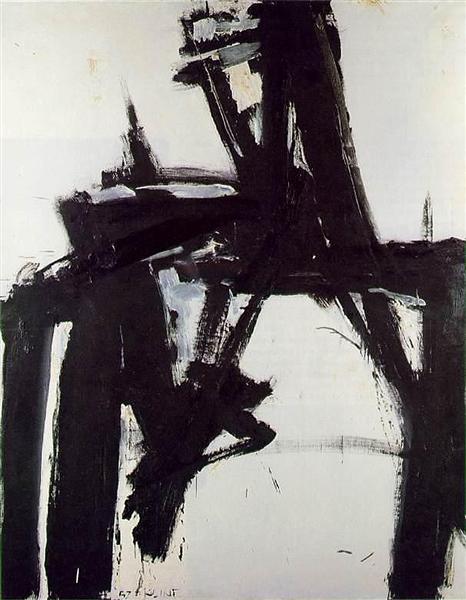
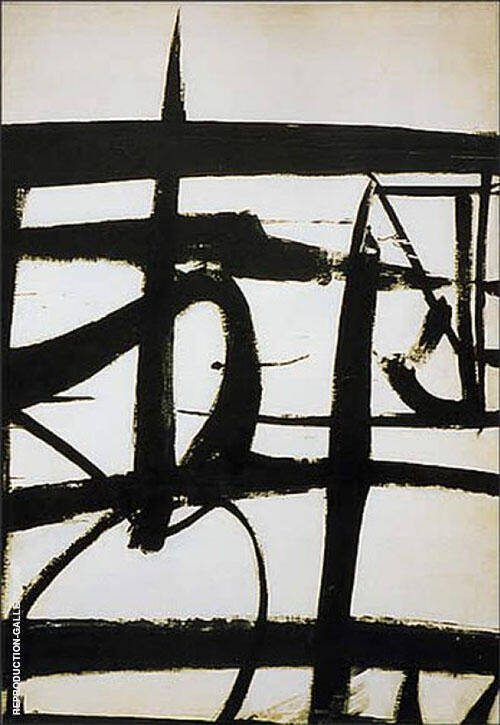


Chief, one of Kline’s earliest breakthroughs, exemplifies his transition into abstract art. Inspired by industrial landscapes and architectural forms, Kline used thick black lines that intersect and overlap, creating a powerful composition that feels both structural and spontaneous. The dominance of black against a white canvas gives Chief a monumental quality, emphasizing the tension between control and freedom, a theme that runs throughout Kline’s work.
Another essential piece, White Forms, explores similar themes but reverses the focus, giving prominence to white shapes that are outlined and defined by black. This inversion of focus reveals Kline’s fascination with space and negative space, creating a dynamic play between foreground and background. The minimal color palette of black, white, and hints of gray intensifies the visual impact of White Forms, allowing viewers to experience the work’s depth and movement without distraction.
Mahoning, one of Kline’s later works, is often noted for its robust use of horizontal and vertical strokes, creating an almost architectural feel. This piece captures Kline’s style at its peak, where his bold, intuitive brushstrokes intersect in a way that feels both balanced and dynamic. Mahoning, like his other well-known pieces, shows why Franz Kline famous paintings continue to captivate viewers: they are classic studies of form, line, and emotion that are depicted in the most basic color schemes.
These iconic Franz Kline paintings are not only masterpieces of abstract art but also highly valued in the art world. Chief, White Forms, and Mahoning are displayed in renowned institutions like the Museum of Modern Art in New York and the Whitney Museum of American Art. Their prices at auction reflect their significance, with Kline's works selling for millions of dollars. Pieces such as Chief have been known to reach up to $10 million, underscoring Kline’s legacy as a pioneer in abstract expressionism. Through his works, Kline proved that simplicity and restraint could evoke profound reactions, making his art both groundbreaking and timeless.


